

The fully automatic variable frequency water supply equipment is equipped with a touch screen for real-time display, supporting manual/automatic switching
With the development of emerging technologies such as the Internet of Things, big data, and artificial intelligence, fully automatic variable frequency water supply equipment is gradually achieving intelligence. Intelligent devices can monitor water quality, quantity, and pressure in real time, automatically adjust operating parameters, and achieve optimized water supply effects. Meanwhile, remote monitoring and fault warning functions have greatly improved the operational efficiency and safety of the equipment. The fully automatic variable frequency water supply equipment achieves intelligent regulation of the water pump through variable frequency technology, effectively avoiding energy waste caused by frequent start stop of the water pump in traditional water supply equipment. According to relevant data, compared with traditional water supply equipment, fully automatic variable frequency water supply equipment can save more than 30% of energy.
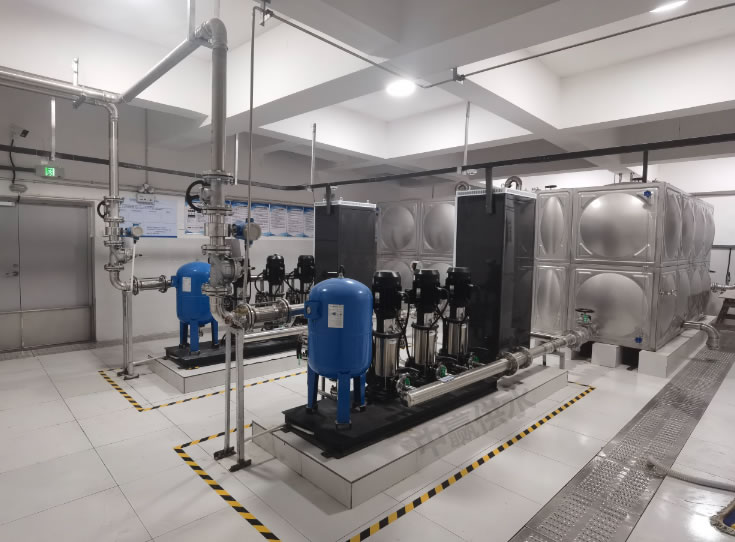
1. Intelligent frequency conversion speed regulation, precise constant pressure water supply
Core function: Real time adjustment of water pump speed through frequency converter, automatic adjustment of water supply pressure according to changes in water consumption, ensuring constant pressure in the pipeline network.
Technical principle: The equipment is equipped with a built-in pressure sensor to continuously monitor the pressure of the pipeline network, feedback the signal to the control system, and dynamically adjust the frequency of the water pump through PID algorithm to avoid water discomfort or equipment loss caused by pressure fluctuations in traditional water supply methods. Compared to traditional constant speed pumps, it can save 30% -50% of electricity, especially during periods of low water usage, with significant energy-saving effects. Eliminate the phenomenon of fluctuating water pressure and ensure the stability of daily water use such as showering and flushing.
2. Fully automatic operation, no need for dedicated personnel to be on duty
Core function: The device has functions such as automatic start stop, fault self check, remote monitoring, etc., achieving unmanned operation.
Technical implementation:
PLC control system: Equipment logic control is achieved through a programmable logic controller (PLC), supporting modes such as timed start stop and cyclic operation.
Human Machine Interface (HMI): Equipped with a touch screen or display screen, it displays real-time parameters such as pressure, flow rate, frequency, etc., and supports manual/automatic switching.
Remote communication: Supports RS485, Ethernet, or wireless modules, and can be connected to building automation systems (BAS) or cloud platforms to achieve remote monitoring and fault alarm.
Reduce labor costs: No need for dedicated personnel to be on duty, reducing the investment of operation and maintenance personnel.
Quick response to faults: push alarm information through SMS or APP for timely processing.
3. Multi pump linkage, intelligent rotation operation
Core function: Supports parallel operation of multiple water pumps, automatically switches between primary and backup pumps based on water consumption, and extends equipment lifespan.
Technical implementation:
Switching between main and backup pumps: Set the main pump, backup pump, and auxiliary pump to start in priority order to avoid prolonged operation of a single pump.
Cycle soft start: Start different water pumps each time to balance equipment wear and reduce maintenance frequency.
Improve reliability: Automatically switch to the backup pump in case of a single pump failure to ensure water supply continuity.
Extend lifespan: Reduce single pump load and minimize mechanical wear by rotating operations.
4. Energy saving design to reduce operating costs
Core function: Reduce energy consumption through variable frequency speed regulation, efficient motor, low resistance pipeline design, and other means.
Technical implementation:
Efficient motor: Adopting IE3/IE4 energy efficiency level motors to reduce energy loss.
Low resistance pipeline: Optimize pipeline layout, reduce head loss, and lower pump head demand.
Sleep function: When the water consumption is extremely low, the device automatically enters sleep mode, further saving energy.
Long term electricity savings: Taking 10kW equipment as an example, the annual electricity savings can reach tens of thousands of kilowatt hours.
Compliant with green building standards: Helps projects pass certifications such as LEED and Green Samsung.
5. Complete protection functions, safe and reliable operation
Core function: It has multiple protections such as overload, short circuit, phase loss, overvoltage, undervoltage, water shortage, and overvoltage.
Technical implementation:
Electrical protection: Overload/short circuit protection is achieved through components such as circuit breakers and thermal relays.
Mechanical protection: Install water flow switches and pressure switches to prevent equipment from running without water or being damaged by overpressure.
Environmental adaptation: With a protection level of IP55, it is suitable for harsh environments such as humidity and dust.
Reduce failure rate: Multiple protection mechanisms reduce the risk of equipment damage.
Ensure water safety: Avoid water outages or water pollution caused by equipment failures.
6. Modular design, easy installation and maintenance
Core function: The device adopts an integrated design, which facilitates quick installation and later maintenance.
Technical implementation:
Standardized modules: Components such as water pumps, frequency converters, and control cabinets are pre installed on the base to reduce on-site installation time.
Quick interface: The pipeline is connected with flanges or clamps for easy disassembly and maintenance.
Diagnostic function: The control cabinet is equipped with a built-in fault code display, making it easy to quickly locate the problem.
Shorten construction period: Factory prefabrication production, on-site installation only takes a few hours.
Reduce maintenance costs: Modular design reduces maintenance complexity, and ordinary electricians can complete basic maintenance.
7. Strong adaptability to meet diverse needs
Core function: Customizable design according to different scenarios, supporting multiple water supply modes.
Technical implementation:
Adjustable pressure range: By setting the parameters of the frequency converter, it can adapt to different pressure requirements of 0.1-2.5MPa.
Multi source switching: supports linkage between municipal water supply and water storage tanks to ensure emergency water supply in case of water outage.
Water quality compatibility: Stainless steel or composite material water tanks can be selected to adapt to different water qualities such as drinking water and reclaimed water.
Flexible application: Suitable for high-rise residential buildings, commercial complexes, hospitals, schools and other scenarios.
Strong scalability: It can be linked with fire protection systems, hot water systems, etc. to achieve an integrated water supply solution.
Application scenarios of fully automatic variable frequency water supply equipment
High rise residential buildings: Ensuring water comfort for high-rise users through constant pressure water supply, while also saving energy and reducing consumption.
Industrial plant area: Provide stable pressure for the production line to avoid affecting product quality due to water pressure fluctuations.
Hospitals/schools: Ensure reliable water supply in critical locations through multi pump linkage and fault protection.
Renovation of old residential areas: replacing the traditional water tank+pump mode, saving space and improving water quality.
- Pre:The renovation of non negative 2026/1/21
- Next:With the promotion of rural re 2026/1/14
